





|
Data & Models
Probe Economics, Inc., began as an econometric modelling shop at a U.S.
university; so models and databases are an important, if not the most important, core
competency of the company. Most of Probes models go back to "Economics
101," which taught us that prices and volumes are determined by the intersection of
supply and demand curves. Probe personnel have command of, and have used successfully in
business situations, some sophisticated techniques, including mixed-integer programming,
dynamic optimal control theory, Rockefellar duality theory, regional input-output models,
and non-linear equation estimation, but these techniques all hark back to that simple,
"Economics 101" principle.
Most of Probes modelling techniques can be found in academic
journals and textbooks, but no-one, other than Probe, has applied them successfully to
real chemical industry business problems. We know which techniques will work, stay within
a budget and deliver results that the client can understand and use. Even though more
sophisticated techniques are available, we often recommend a simpler approach for the
client, in order to stay within the budget and mesh better with the clients way of
thinking and working.
One of Probes better-developed models is for world petrochemicals. This model,
which is coded into thousands of lines of linked electronic spreadsheets, can be depicted
roughly as follows:
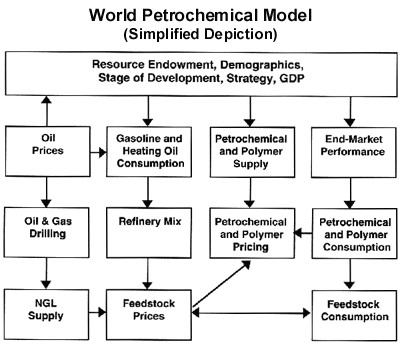
Typical of many of Probes models, the analysis begins at the top
and proceeds downward (sometimes called a "Top-Down" approach). It begins with
macro factors such as a countrys resource endowment, demographics, stage of
development, political system, trade strategy and economic output (GDP). The factors drive
the supply and demand for petrochemicals and polymers, as well as the development of the
energy and refining sector that is so important to petrochemicals. Oil prices and resource
endowments determine the level of oil and gas drilling and, ultimately, the supply of
hydrocarbons for use in chemical production. Demographics and income levels determine the
demand for heating oil, gasoline and other refined products, which in turn determine
refinery configuration and the prices of chemical feedstocks. In the end, this methodology
generates internally-consistent and reasonably-accurate forecasts of chemical supplies,
demands and prices by country and region.
Probe personnel have developed and successfully used similar models for
chlor-alkali, other inorganic chemicals, rubber chemicals, oil and gas, uranium and a wide
variety of other materials. This body of knowledge and experience positions Probe to build
a model that addresses your specific business problem and provides insights and approaches
that would not otherwise be apparent.
In the following, we provide a list of the chemicals, polymers, hydrocarbons and
economic indicators covered by various Probe models and databases.
CHEMICALS, POLYMERS, HYDROCARBONS
AND ECONOMIC INDICATORS
COVERED IN PROBE MODELS AND DATABASES:
A. Regular Multiclient Reports (1)
Energy and Economic Indicators
For the U.S.:
GDP
GDP Price Deflator
U.S. Unemployment Rate
Value of Dollar
Crude Oil Price
Natural Gas Price
Electric Power Costs
Price Index for Chemicals
Chemical Plant Cost Index
For Most Other Countries and Regions:
GDP
Demographics
Industry Mix
Motor Vehicle Registration
Motor Vehicle Production
Wood Pulp Production
Alumina Production
Other Industry Indicators
Feedstocks and Oxygenates
Ethane
Propane
n-Butane
n-Butylene
Isobutylene
ULR Gasoline
No. 2 Heating Oil
Octane Barrels (Valuation)
Pygas
LSR Naphtha
Gasoil
Low Sulfur Residual Fuel Oil
Mixed Xylenes
Toluene
Methanol
MTBE
Fuel Ethanol
Basic Petrochemicals
Ethylene
Propylene
Butadiene
Benzene
Orthoxylene
Paraxylene
Monomers and Intermediates
Acetone
Acrylonitrile
Cumene
Cyclohexane
DMT/PTA
Ethylene Dichloride
Ethylene Glycol
Ethylene Oxide
Phenol
Phthalic Anhydride
Propylene Glycol
Propylene Oxide
PTA/DMT
Styrene
Vinyl Chloride Monomer
Polymers
ABS
Acrylic Fiber
HDPE
LDPE
LLDPE
Nylon Fiber
Polybutadiene Rubber
Polyester Resin
Polyester Fiber
Polyester Film
Polypropylene
Polystyrene
Polyvinyl Chloride
SB Rubber/SB Latex
Inorganic Chemicals
Ammonia
Caustic Soda
Chlorine
Hydrogen Peroxide
Soda Ash
Sodium Chlorate
Sulfur
B. Reports, Databases and/or Models Updated On An
"As-Needed" Basis (2)
- Acrylic Acid
- Activated Alumina
- Adipic Acid
- Ammonium Sulfate
- Aniline
- Anthraquinone
- Bisphenol-A
- Butanediol
- n-Butanol
- Butyl Acrylate
- Calcium Carbonate
- Caprolactam
- Carbon Black
- Chloroprene Rubber
- Clays
- Coal Tar
- Coal Tar Chemicals
- Corn Starch
- Corn Sweeteners
- Cresylic Acids
- DMT/PTA
- DOP/DIDP/DBP/DIBP
- Plasticizers
- Dextrose
- Dimethyl Ether
- Dinitrotoluene
- EPDM Rubber
- ETBE
- EVA/VAE Resins
- and Adhesives
- Environmental
- Technologies
|
- 2-Ethyl Hexanol
- 2-Ethylhexyl Acrylate
- FCC Catalysts
- Formaldehyde
- Fumaric Acid
- Glycerine
- Glyoxal
- Hydrocarbon Resins
- and Intermediates
- Hydrochloric Acid
- Hydrogen Cyanide
- Industrial Gases
- Isobutanol
- Isophthalic Acid
- Isoprene
- MDI/PMDI
- Maleic Anhydride
- Manganese Chemicals
- Methyl Ethyl Ketone
- Methyl Isobutyl Ketone
- Methyl Isopropyl Ketone
- Mononitrobenzene
- Neopentyl Glycol
- Nitric Acid
- Nitrile Rubber
- Other Oxo products
- Parachlorobenzaldehyde
- Phenolic Resins
- Phosgene
- Phosphoric Acid
- Polyvinyl Acetate
- Polyvinylidene Chloride
- Potash
|
- Potassium Carbonate
- Potassium Hydroxide
- Potassium Permanganate
- Precious Metal Catalysts
- Prenol
- Pyrethroid Intermediates
- Resorcinol Resins
- Rubber Chemicals
- Sodium Cyanide
- Sodium Methylate
- Sodium Sulfate/Sulfite
- Solvents
- Soy Protein Binders
- Styrene Block Copolymers
- Sulfates/Sulfites
- Sulfuric Acid
- Sulfur Dioxide
- Synthesis Gas
- Tall Oil and Derivatives
- Titanium Dioxide
- Toluene Diamine
- Toluene Diisocyanate
- Trimellitic Anhydride
- Trimethylolpropane
- Urea
- Urethane Elastomers
- Vinyl Acetate Monomer
- Vinylidene Chloride
- Waxes
- White Mineral Oil
- Zeolite Cats/Adsorbents
- Zinc Oxide
- Epoxy Resins
|
Notes:
1. Some multiclient reports are updated semi-annually.
Others are updated every two or three years. Some reports have a full, quantitative
work-up of supply, production, exports, imports, demand, cost, margin and price, while
others only deal with one or two of these.
2. Existing materials may include only a database or cost
model, or may include a complete study. Some portions of this information are updated
every year or two, while other portions may not have been updated for 10 years.
For more information, E-Mail us at info@ProbeEconomics.com
Copyright © 2006 Probe Economics Inc. All rights reserved.
|
|